Grid batteries explained: why BESS is the fastest-growing part of the battery market
Storage pack prices fell to $70/kWh in 2025 and four-hour batteries now beat gas peakers on cost – but in Poland, market rules still decide how much gets built.
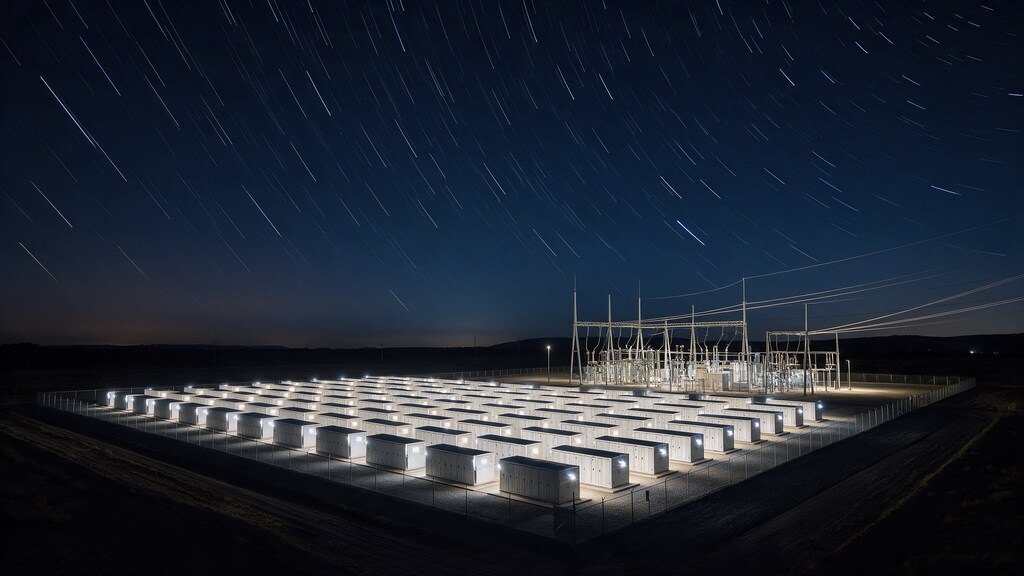
A battery energy storage system (BESS) is a grid-connected battery – typically containers of lithium iron phosphate (LFP) cells with power electronics – that charges when power is cheap or abundant and discharges when it is scarce. It earns money by shifting energy in time, balancing the grid and providing capacity.
Costs have collapsed
BloombergNEF's 2025 survey found that battery packs for stationary storage fell to $70/kWh, 45% lower than in 2024.1 Products have grown in scale and durability: CATL's Tener system, for example, puts 6.25 MWh into a 20-foot container and is rated at more than 15,000 cycles.2
As a result, Wood Mackenzie now finds four-hour battery storage cheaper than open-cycle gas turbines in all 43 markets where both were modelled.3
Deployment is accelerating
In September 2026 alone, 20.4 GWh of grid-scale BESS was deployed worldwide, up 61% year on year; year-to-date installations were up 43%.4 New buyers are appearing too: Redwood Materials has run a 12 MW / 63 MWh microgrid built from second-life EV packs at a Crusoe data centre in Nevada.5
In Poland, market design matters as much as cost
Poland shows that cheap batteries are not enough. In the December 2025 capacity auction for delivery in 2030, the de-rating factor for batteries was cut to around 13%, from 60% a year earlier; battery awards fell to about 685 MW of obligations, from 2.5 GW in 2024, while gas won around 2,400 MW.6 Projects that already hold contracts are now being built: R.Power energised its first standalone Polish BESS, the 5 MW / 10 MWh Herby project, in October 2026, backed by a capacity contract from the December 2024 auction.7
What to watch: the revenue mix – with smaller capacity payments, Polish projects increasingly depend on trading and balancing income, which favours operators with strong optimisation partners.
What it means for Central & Eastern Europe
BESS integrators and manufacturers from Poland, Czechia and Croatia are listed in our directory. For the economics behind it, read our CEE Take Batteries now beat gas peakers on cost – Poland's capacity market still points the other way.
Sources
-
Lithium-ion battery pack prices fall to $108 per kilowatt-hour – BloombergNEF, 9 Dec 2025 ↩
-
CATL launches Tener energy storage system with 5-year 0-attenuation – CnEVPost, 10 Apr 2024 ↩
-
Four-hour battery storage now beats gas peaking on cost globally – Wood Mackenzie, 8 Oct 2026 ↩
-
20.4GWh grid-scale BESS deployed globally in September, up 61%; YTD installs up 43% – Energy-Storage.news, Oct 2026 ↩
-
GM bets big on energy storage for data centers and the grid – TechCrunch, 9 Jun 2026 ↩
-
BESS wins in Poland capacity market falls for the first time, de-rating cut to blame – Energy-Storage.news, 19 Dec 2025 ↩
-
R.Power's first standalone energy storage project in Poland enters operations – Energy Global, 22 Oct 2026 ↩