Thermal runaway explained: from five-minute warnings to "no fire, no explosion"
China's new battery standard requires that a single-cell thermal runaway causes no fire or explosion – pushing pack makers towards better barriers such as aerogels.
Thermal runaway is the chain reaction every battery engineer designs against: a fault heats a cell, the heat triggers further reactions inside it, and the cell releases heat and gas faster than it can be cooled. The real danger for a pack is propagation – when neighbouring cells reach the same tipping point.
The rules just got stricter
China's mandatory standard for traction batteries, GB 38031-2025, took effect on 1 July 2026. It requires batteries to achieve "no fire, no explosion" after thermal runaway in a single cell. The previous rules allowed fire or explosion as long as occupants were warned at least five minutes in advance. The standard also adds bottom-impact tests and long-term fast-charge cycling.1
How propagation is stopped
Heat travels from a failing cell to its neighbours mainly by conduction, but also through hot gases, particles, busbars, cooling plates and air gaps.2 Pack designers therefore combine several measures: barriers between cells, venting paths for gas, and electrical and mechanical design that avoids bridges between cells.
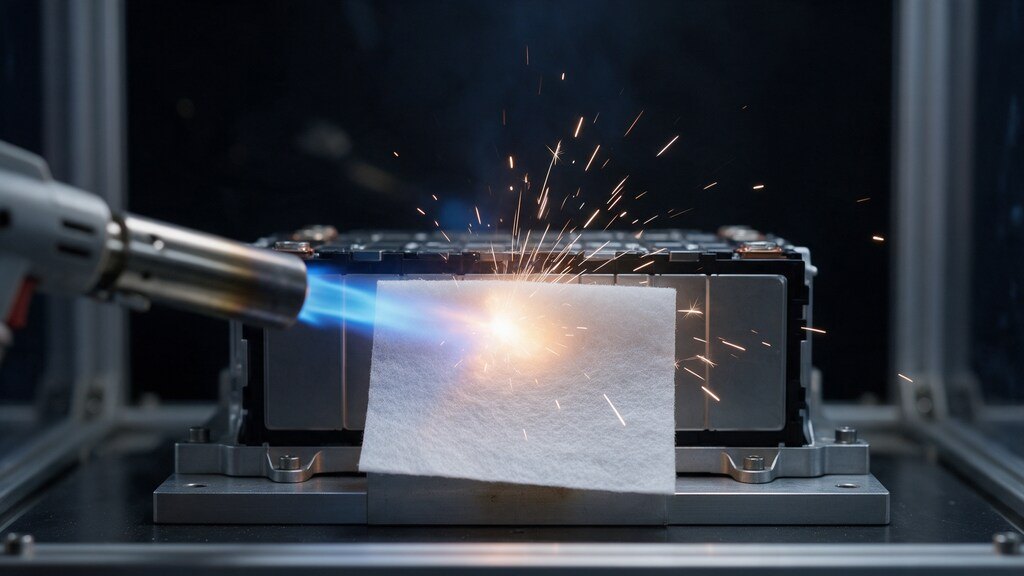
Aerogel barriers target the most important path, cell-to-cell conduction. In a test described by Aspen Aerogels, a 2 mm sheet of its PyroThin silica aerogel withstood a propane torch at 1,000 °C. Conventional polyurethane and silicone foam pads top out at around 100–300 °C, so they cannot withstand a runaway event.2 The company's stated goal: a single cell going into runaway should be "a maintenance event, not a safety event".2
Chemistry helps too
Some chemistries are inherently less prone to overheating. Developers of sodium-ion grid storage, for example, plan systems without cooling and fire-suppression equipment because the cells overheat less, according to a 2026 report on GM's plans.3
What to watch: whether Europe follows China's "no fire, no explosion" principle in its own vehicle and storage rules – that would change pack design and test programmes for European suppliers.
What it means for Central & Eastern Europe
The region's pack assemblers, BESS integrators and test laboratories – including battery test labs in Poland and Czechia – will see these requirements first through their customers' specifications. Propagation tests and barrier materials are becoming a standard part of pack development. Find testing and equipment companies in our directory.
Sources
-
China's toughest battery safety rules take effect in July, raising bar for makers – CnEVPost, 30 Jun 2026 ↩
-
Thermal runaway in EV battery packs: designing a mitigation strategy – Charged EVs, 14 Apr 2023 ↩↩↩
-
GM bets big on energy storage for data centers and the grid – TechCrunch, 9 Jun 2026 ↩