Tabless cells, cell-to-pack and cell-to-chassis explained
Fewer modules, shorter current paths and cells built straight into the pack or the car – how battery design, not only chemistry, is raising range and cutting cost.
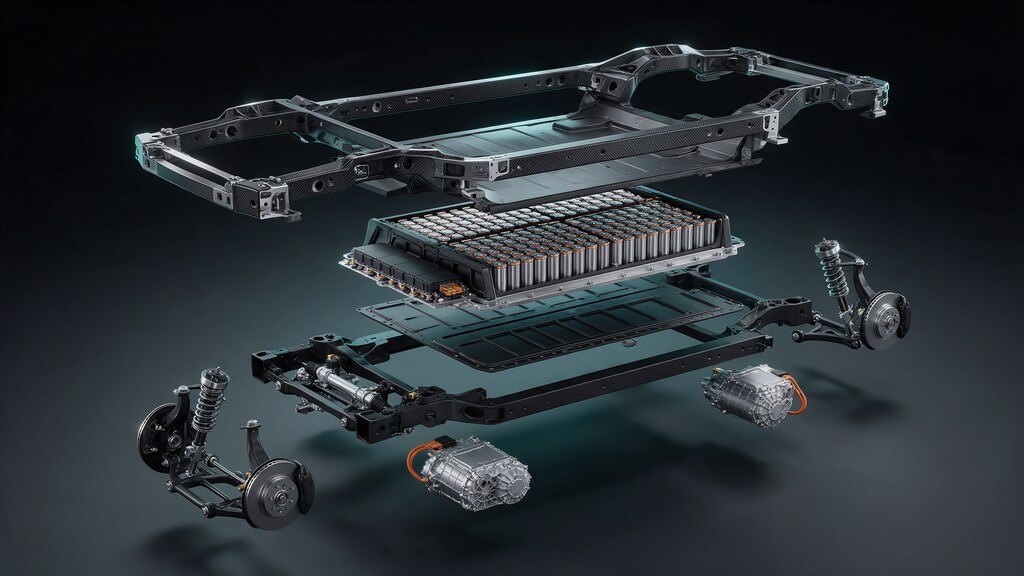
Range and cost do not depend on chemistry alone. Over the past few years battery makers have redesigned how cells are built and how they are packaged – removing parts that add weight, resistance and cost.
Tabless cells: a shorter path for current and heat
In a conventional cylindrical cell, current leaves the electrode through a small metal tab. In 2020 Tesla presented "the first tabless cylindrical cell design" in its 46 × 80 mm "4680" format, arguing that it solves the thermal problem of larger cells. Tesla claimed the format offers five times the energy and six times the power of its previous cells, and that the form factor alone increases range by 16% and cuts cost per kWh by 14%.1
Cell-to-pack: removing the module
Traditional packs group cells into modules, which are then assembled into a pack. Cell-to-pack (CTP) designs skip the module level. CATL's third-generation CTP battery, Qilin, uses over 72% of the pack volume for energy storage, reaches 255 Wh/kg and can be charged to 80% in 10 minutes, according to the company.2
BMW's sixth-generation eDrive in the iX3, built in Debrecen, Hungary, also integrates cylindrical cells directly into the pack ("cell to pack"), with cell-level energy density 20% higher than the fifth generation. The iX3 50 xDrive has 112.2 kWh of usable capacity and charges at up to 400 kW.3
Cell-to-chassis: the battery as part of the car
The next step takes the idea further: the pack itself becomes part of the vehicle structure, so that floor and battery enclosure share load-bearing parts. This saves material and height, but it also changes how the battery is accessed, repaired and eventually recycled.
What to watch: repairability – the more tightly cells are integrated into pack and body, the more important diagnostics, standards and dismantling procedures become, including under the EU battery passport.
What it means for Central & Eastern Europe
New pack architectures are being industrialised in the region: BMW builds its Neue Klasse iX3 with cell-to-pack integration in Hungary.3 For the region's pack assemblers, equipment makers and test labs, bigger cells and fewer modules change requirements for joining, thermal management and end-of-line testing. Find them in our directory and compare vehicle batteries in our E-mobility database.
Sources
-
Tesla 4680 battery cell: bigger, more power and energy – Electrek, 22 Sep 2020 ↩
-
CATL unveils Qilin battery – CnEVPost, 23 Jun 2022 ↩
-
The all-new BMW iX3 – BMW Group PressClub, 2025 ↩↩