"Beyond fire suppression: gas management and explosion risks in battery energy storage systems"
Putting out the visible fire does not make a battery container safe. Vent gases can keep building up after suppression – which is why detection, ventilation, suppression and explosion protection have to be designed as one system.
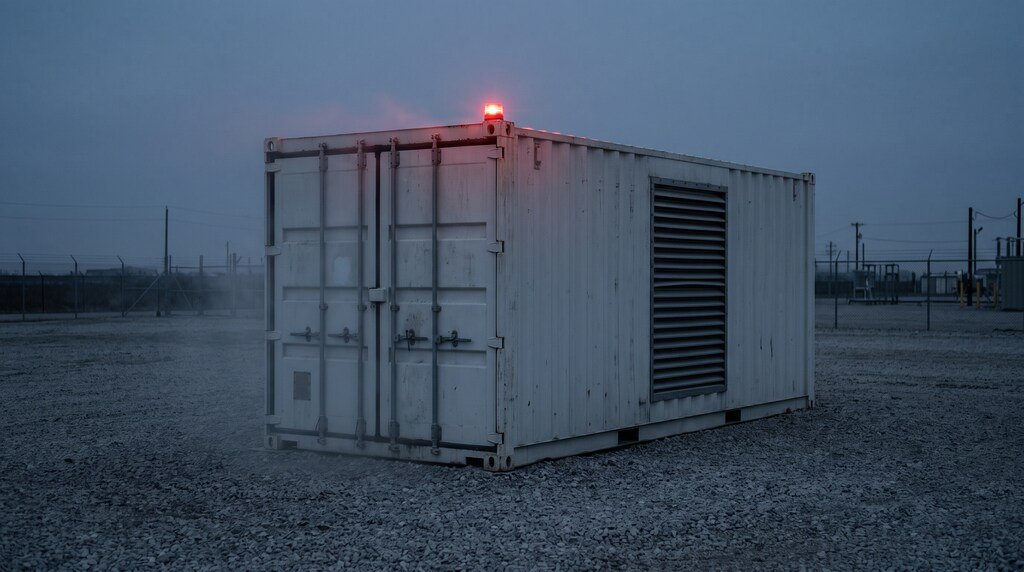
In a battery energy storage system (BESS), extinguishing the visible fire is not the same as making the installation safe. A cell can continue to heat and vent after flames have disappeared, leaving combustible gases inside the enclosure. The danger may shift from an active fire to a gas mixture that responders cannot see.
That distinction is easy to overlook when protection is designed around alarms and suppression at room or container level. Thermal runaway begins inside a cell. By the time a system detects the event and acts, heat and gases may already be affecting nearby components. Gas management therefore needs to be considered from the first stages of an incident–not only after suppression has operated.
The fire may be out. The hazard may not be.
Thermal runaway produces heat, pressure and vent gases. Depending on the cell chemistry and the conditions of failure, the mixture can include hydrogen, carbon monoxide, carbon dioxide, hydrocarbons, electrolyte vapours and toxic compounds such as hydrogen fluoride. The amount and composition are not fixed; they vary with battery design, state of charge and how the cell fails124.
Room-level suppression can control external combustion, but it does not necessarily stop the reactions inside a damaged cell. That is an important distinction in practical response: extinguishing flames is one task, cooling the battery and limiting propagation are others, and gas hazards may remain after all three have been addressed to some extent58.
The 2019 McMicken incident in Arizona is a sobering example. DNV GL's investigation describes cascading thermal runaway and the accumulation of flammable gases in the container. Responders opened the door roughly three hours after the initial event; an explosion followed shortly afterward and injured firefighters. The report concluded that the discharged clean-agent system had operated as designed, but it could not stop cascading thermal runaway8. McMicken should not be treated as a blueprint for every battery incident. It does, however, show why the status of a suppression system cannot by itself establish that an enclosure is safe to enter.
Gas does not distribute evenly
Once gases are released into a container, where they collect matters as much as how much is released. Enclosure layout, airflow, obstacles and the location of the venting source can create areas with very different concentrations. A sensor reading from one point may not describe conditions elsewhere in the space. Studies of battery vent gases and their dispersion have documented the variety of gas mixtures and the hazards they can create1234.
This is one reason detection needs to be planned around the enclosure, not simply added to it. The gas being monitored, sensor response, location, airflow and alarm logic all affect whether a warning arrives in time. Recent modelling work on hydrogen dispersion in battery cabins has examined how gas distribution changes within the enclosure and how that affects sensor placement9. A detector is useful only to the extent that it can detect the hazard where and when it develops.
Protection has to work as a system
I see a gap between the point where an incident begins and the point where a protection system acts. Thermal runaway may start in one cell or at a connection; conventional detection and suppression often operate at a broader room or container scale. This delay matters because the event can spread before the system responds.
There is another issue: detection, power and control are connected in a chain. Each link has to function during the emergency. And the battery itself is not the only place to look. A 2024 analysis by EPRI, PNNL and TWAICE found integration, assembly and construction to be the most common assigned root cause among the 26 incidents in its database for which a cause could be identified–10 incidents11. Connections, busbars, cabling, power electronics and other balance-of-system components deserve attention alongside the cells.
Ventilation, suppression and explosion protection also interact. Ventilation may help reduce combustible-gas concentrations, but its effect depends on the enclosure and the event. Suppression systems have their own requirements, including hold time and the conditions under which gases can safely be removed. Large-scale experiments published in 2026 found that suppression performance, cooling, gas accumulation and ventilation affect one another; the study also observed deflagration when flammable gases were not adequately vented5. There is no single sequence that can be applied to every BESS without considering its design and hazard analysis.
Some codes specify concentration criteria such as 25% of the lower flammable limit (LFL) for defined ventilation or explosion-prevention arrangements. That is a requirement within particular code provisions and scenarios, not a universal safe threshold for every battery enclosure610. Local concentrations, detector coverage, airflow and the available discharge path still need to be considered.
Designing for what happens next
Battery fire protection is often discussed in terms of preventing ignition or stopping flame spread. Both remain essential, but the incident does not end at extinguishment. The enclosure may still contain hot cells, residual gases or conditions that make access dangerous. Responders need information about what is happening inside, and the system needs a plan for monitoring and managing the enclosure after suppression.
Test results and standards are part of that decision, but their scope matters. UL 9540A evaluates thermal-runaway fire propagation and fire and explosion characteristics under defined test conditions7. Those results help inform design; they do not automatically describe every battery configuration or installation.
For me, the practical question is not simply whether a BESS has a fire suppression system. It is whether the protection strategy accounts for the event from its point of origin through gas release, propagation, suppression and the period afterward. That means looking beyond the cells, and making sure detection, ventilation, suppression and explosion protection are designed to work together.
Sources
-
Wang, S., Wang, Q., Xu, L., Sun, Y., Feng, X., & Wang, H. (2024). A review on mechanisms, characteristics and relating hazards of vent gases from thermally abused Li-ion batteries. Journal of Energy Storage, 84, 110892. ↩↩
-
Bugryniec, P. J., Resendiz, E. G., Nwophoke, S. M., Khanna, S., James, C., & Brown, S. F. (2024). Review of gas emissions from lithium-ion battery thermal runaway failure–Considering toxic and flammable compounds. Journal of Energy Storage, 87, 111288. ↩↩
-
Wang, P., et al. (2025). Experimental study on the venting and diffusion patterns of flammable gases during thermal runaway in LiFePO4 battery packs for energy storage stations. Journal of Power Sources, 645, 237200. ↩
-
Baird, A. R., Archibald, E. J., Marr, K. C., & Ezekoye, O. A. (2020). Explosion hazards from lithium-ion battery vent gas. Journal of Power Sources, 446, 227257. ↩↩
-
Meraner, C., Fjærestad, J. S., Vullum-Bruer, F., Stefanska, M., & Li, T. (2026). Suppression of battery energy storage system fires. Fire Safety Journal, 162, 104727. ↩↩
-
NFPA. (2026). NFPA 855: Standard for the Installation of Stationary Energy Storage Systems (2026 edition). ↩
-
UL Solutions. (2026). UL 9540A: Test Method for Evaluating Thermal Runaway Fire Propagation in Battery Energy Storage Systems. ↩
-
DNV GL Energy Insights USA, Inc. (2020). McMicken Battery Energy Storage System Event–Technical Analysis and Recommendations. Report No. 10209302-HOU-R-01, issued July 18, 2020. ↩↩
-
Jin, X., Feng, Y., Li, P., Wang, B., Fu, K., & Cao, C. (2026). Numerical analysis of hydrogen dispersion within lithium-ion battery cabins for gas-sensitive early safety warning. Chinese Journal of Chemical Engineering. ↩
-
California Fire Code (2025 edition, with January 2026 errata). Chapter 12, Energy Systems, Section 1207.6.1.1: Ventilation based on LFL. ↩
-
EPRI, PNNL & TWAICE. (2024). Insights from EPRI's Battery Energy Storage Systems (BESS) Failure Incident Database: Analysis of Failure Root Cause. EPRI white paper, May 2024. ↩