EU battery plants need an exception log before they scale AI inspection
As new cell plants ramp up, AI-assisted inspection will sometimes be wrong. A shared record of those exceptions helps plants learn faster, train staff and show customers and lenders how decisions are made.
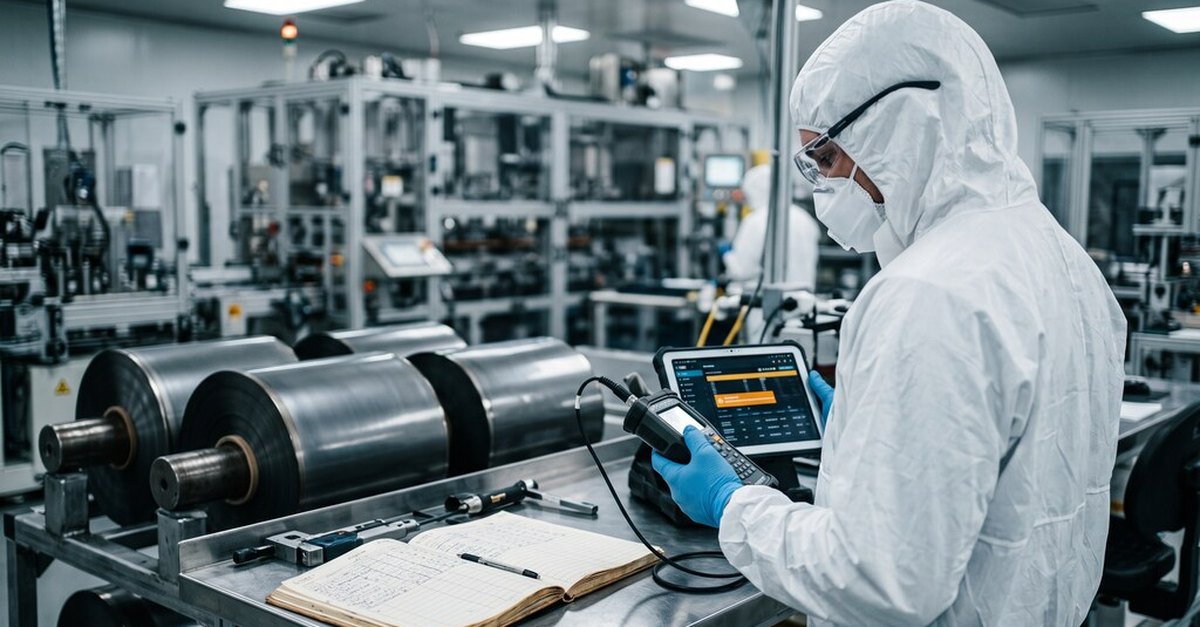
Europe is trying to expand battery manufacturing at a difficult moment. The European Commission's Battery Booster Facility closed its first application round on 30 September, with up to €1.5 billion in interest-free loans for cell manufacturers moving from pre-series production to full commercial operation.1 That support addresses a real bottleneck. Yet the operational test of a factory comes after the machinery starts running: can its people identify, explain and correct the exceptions that automated systems miss?
AI helps – until conditions change
Artificial intelligence can play a useful role in inspection and process monitoring. The EU-backed DigiCell project explicitly investigates the combination of measurement tools, digital models and AI across battery pilot lines, with goals that include reducing waste and supporting quality control.2 These are worthwhile applications. But a model that appears accurate on familiar production data can still reach a misleading conclusion when a material, process setting or sensor condition changes.
Treat the exception log as an operating asset
Every time an AI-assisted inspection system flags a batch incorrectly, overlooks a defect or cannot reconcile measurements, staff should record the issue in a shared log. Each entry should identify the material lot and process step, the model version if applicable, the underlying measurements, the human decision and the confirmed outcome. That record becomes the basis for learning, not just a list of embarrassing anomalies.
Consider a hypothetical quality-control station screening electrode coatings. An image-analysis tool marks some measurements as acceptable, although an operator suspects a problem after comparing the output with another instrument. A rushed supervisor might wave the concern through because the automated result arrives immediately and looks authoritative. A stronger procedure requires the operator to pause the affected batch, document the disagreement, escalate it to a named decision owner and record the verified explanation before release.
Over several months, the log can reveal recurring failure conditions – an unusual lighting condition, a change of material supplier or a maintenance adjustment that repeatedly produces contradictory signals. Managers can then distinguish a process change from a software issue and decide whether to retrain the model, revise the measurement protocol or adjust the workflow, testing each intervention against the recorded exceptions.
Measure the right things
Do not judge a plant's AI deployment solely by inspection speed or model accuracy. Count how many exceptions required investigation, how long they took to resolve, how often reviewers overturned an automated result and how often the same mistake reappeared after corrective action. A high initial exception count may reflect attentive staff or a newly commissioned line rather than a poor system. Leaders should look at trend and severity – and not punish employees for reporting problems.
Ramp-up is when knowledge forms
This matters during ramp-up because operational knowledge is still forming. Senior technicians may know which unusual readings need investigation, but that knowledge rarely appears in an equipment vendor's demonstration. Junior operators need a structured path to the same judgment. Giving each exception a documented owner creates opportunities for coaching and keeps important knowledge from living in one person's memory. The log can later supply anonymised training exercises for new staff.
The Commission's Joint Research Centre reported in May that Europe needs a skilled and experienced battery workforce, alongside lower costs and other measures, to improve competitiveness.3 The word "experienced" is crucial. Experience accumulates when workers handle unusual cases, see the consequences of decisions and compare what they expected with what actually happened. Removing those opportunities in the name of automation can weaken the expertise a growing plant needs.
Recommend versus decide
Management should draw a clear line between actions AI may recommend and decisions it may execute. A suggestion to inspect another sample is easy to reverse; releasing a production lot into the next process stage is not. Plants should set different approval thresholds for these actions, backed by a traceable chain of evidence, and give operators an explicit way to suspend a workflow without being treated as obstacles to productivity.
Before rolling an inspection tool out to more lines, managers could run a practical drill: give operators simulated measurement conflicts drawn from documented or invented training cases, ask them when to stop the process and require an explanation based on actual records. Supervisors should evaluate not only the answer but also the escalation route, the source checks and the quality of documentation. Repeating the drill with different scenarios shows whether staff have learned a transferable skill.
Why it matters in Central & Eastern Europe
Battery plants expanding in Poland, Hungary, Slovakia and Czechia face shifting equipment settings, materials and staff experience as production ramps up. An exception log helps operators document when AI inspection results conflict with measurements, assign responsibility for resolving disagreements and avoid passing uncertain batches into the next production stage. For firms seeking financing and customer confidence, it also provides a credible record: instead of asserting that an AI system is reliable, the plant can show its testing boundaries, failure patterns and the decisions used to improve it. (For the cost side of ramp-up, see our explainer on gigafactory yield and scrap rates.)
The bottom line: Europe's battery ambitions depend on plants that run consistently, safely and economically while their workforces learn new technology. AI can help – provided managers make its errors visible and give workers the authority to act.
Sources
-
Battery Booster Facility – call for proposals – European Commission ↩
-
DigiCell – project reporting – CORDIS, European Commission ↩
-
Battery technology in the European Union – 2025 status report – European Commission Joint Research Centre, 20 May 2026 ↩