Gigafactory yield explained: why scrap rates decide who survives
New battery plants can scrap a large share of their output during ramp-up – and every percentage point costs millions. Why the industry's focus is moving from capacity to yield.
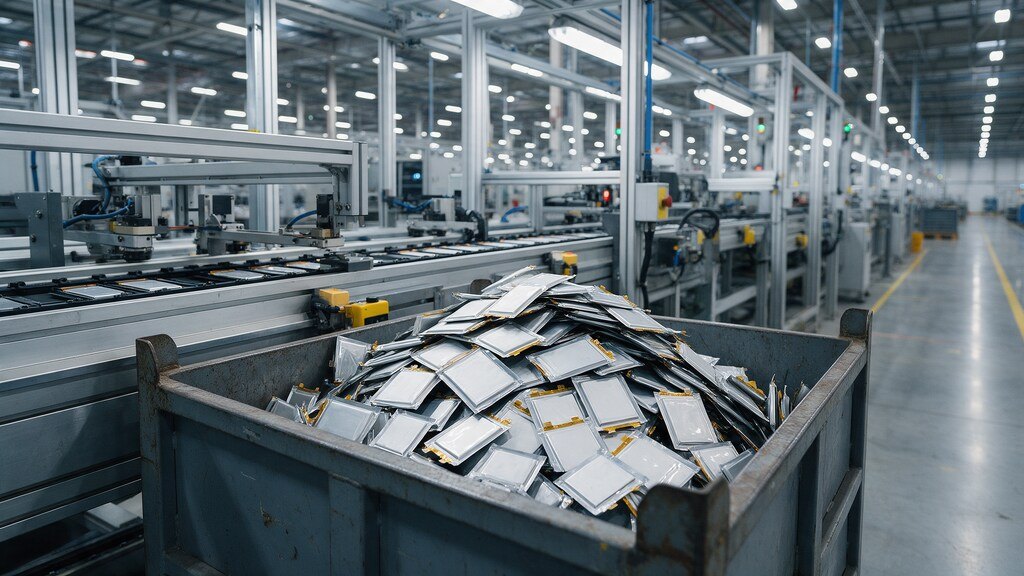
For years the battery industry measured progress in gigawatt-hours of announced capacity. Today the more telling number is yield: the share of cells that leave the line good enough to sell. A plant that scraps a quarter of its output is paying for materials, energy and labour it cannot sell.
How much is thrown away
Fraunhofer FFB, Germany's battery research factory, writes that scrap rates of 15 to 30 per cent in the first few years are common in battery cell production, and that scrap is still around 10 per cent after five years. It estimates that each percentage point of scrap costs about €30,000 per day – roughly €10 million per year – and that a 30 per cent rejection rate at full capacity costs about €900,000 per day.1
The earliest phase can be far worse. Analysts quoted by Autoweek put scrap at 80–90% during the very first pilot production, and said reaching profitability can take three or four years. One analysis put the Tesla/Panasonic Gigafactory's scrap rate at 84% in the third quarter of 2017, soon after production began; by 2019 analysts were told yields had reached 75%.2
Where the time goes
After assembly, every cell has to be formed – charged and discharged for the first time under controlled conditions – and then aged and tested. These formation and ageing steps are the most time-consuming phases of cell production, and the longer cells occupy floor space, the higher the cost.3
The shift to digital factories
The levers are well known: tighter process control in electrode coating, drying and assembly; inline measurement and early detection of defects instead of discovering them at end-of-line testing; and data from every station linked to each cell. Voltaiq estimates that cutting scrap by a single percentage point can be worth tens of millions of dollars in additional annual profit.2
What to watch: yields at Europe's newer cell plants – capacity announcements matter less than how quickly lines reach stable, single-digit scrap rates.
What it means for Central & Eastern Europe
Central & Eastern Europe hosts large cell plants and a growing base of equipment makers, analytical-instrument developers and test labs. For them, the industry's turn from building capacity to raising yield creates demand for process monitoring, inspection and testing. Find these companies in our directory.
Sources
-
Mastering the ramp-up of battery production – white paper – Fraunhofer FFB, 17 Oct 2024 ↩
-
Battery plant scrap rates can hit 90% at ramp up, but the situation is improving – Autoweek, 5 Feb 2024 ↩↩
-
Improving Li-ion cell formation throughput – Battery Technology (sponsored by Keysight), 4 Oct 2023 ↩