Battery recycling and second life explained: closing the loop
EU rules set lithium recovery and recycled-content targets, while retired EV and bus batteries find a second job in stationary storage – here is how the circular battery economy works.
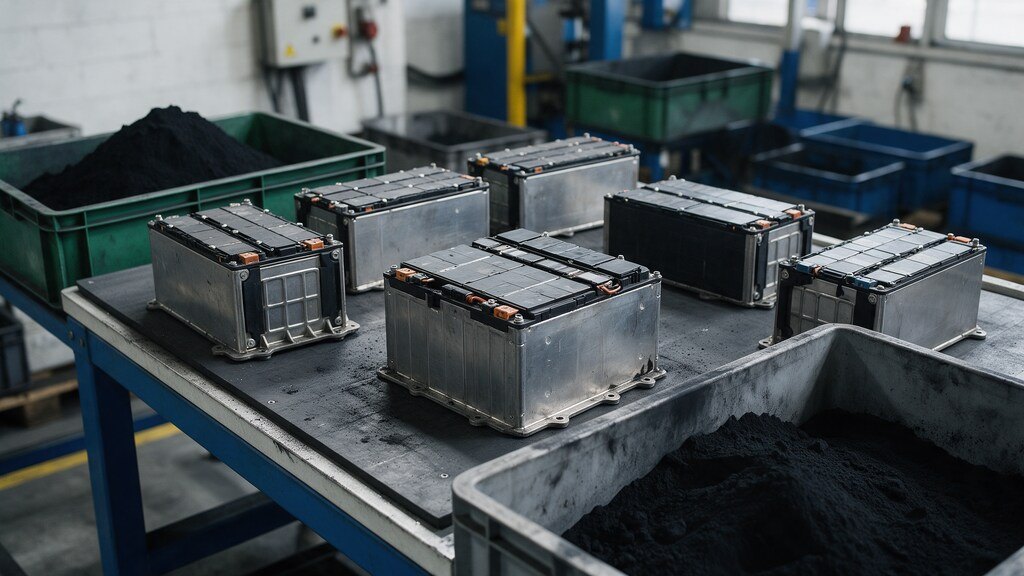
A lithium-ion battery that leaves a car still contains valuable lithium, nickel, cobalt, copper and aluminium – and often most of its capacity. The circular battery economy has two routes: reuse the battery in a less demanding application, or recycle it and return the materials to new cells.
Route 1: second life
An EV or bus battery that no longer meets vehicle requirements can still store energy for years in a stationary system. In 2025 Connected Energy and Forsee Power announced a grid-scale storage system built from batteries that have finished their first life in electric buses. It reuses Forsee's ZEN 35 and ZEN 42 packs, which are installed in about 1,500 electric buses in Europe. The first 2.5 MWh system was scheduled to start operating in the UK in the fourth quarter of 2025, with later projects expected to exceed 25 MWh.1 At larger scale, Redwood Materials has run a 12 MW / 63 MWh microgrid of second-life EV packs at a Crusoe data centre in Nevada.2
Route 2: recycling
Batteries that cannot be reused are shredded into "black mass" and processed – increasingly by hydrometallurgy, which dissolves the metals and separates them chemically – to recover materials for new cathodes.
The EU Battery Regulation sets the targets. Recovery of lithium from waste batteries must reach 50% by the end of 2027 and 80% by the end of 2031.3 New industrial, EV and certain automotive batteries will have to contain minimum shares of recycled cobalt, lead, lithium and nickel from August 2031,4 with initial levels of 16% for cobalt, 85% for lead and 6% each for lithium and nickel.3 Collection targets also rise, for example to 61% for light-vehicle batteries by the end of 2031.3
Why the two routes compete – and complement each other
Second life delays recycling, but it can extract more value from each battery first. The EU battery passport, with state-of-health data for individual EV and industrial batteries from February 2027, should make it easier to decide which route a battery takes.5
What to watch: whether recyclers get access to passport data on individual batteries – the rules on "legitimate interest" access were still being finalised in mid-2026.5
What it means for Central & Eastern Europe
The region already has battery recyclers: our directory lists AE Elemental in Poland, SungEel HiTech in Hungary and Kovohutě Příbram in Czechia. With EU recycled-content rules starting in 2031, locally recovered materials could become a selling point for cell makers in the region.
Sources
-
Forsee Power & Connected Energy to roll out second-life stationary storage system in Europe – electrive, 6 May 2025 ↩
-
GM bets big on energy storage for data centers and the grid – TechCrunch, 9 Jun 2026 ↩
-
EU Council adopts new regulation on batteries and waste batteries – Waste Management World, 11 Jul 2023 ↩↩↩
-
EU Sustainable Batteries Regulation – Baker McKenzie, updated 1 Jan 2026 ↩
-
The EU battery passport: what it requires, who benefits, who pays – ElevenEs, Jul 2026 ↩↩